Workflows Benchmarks
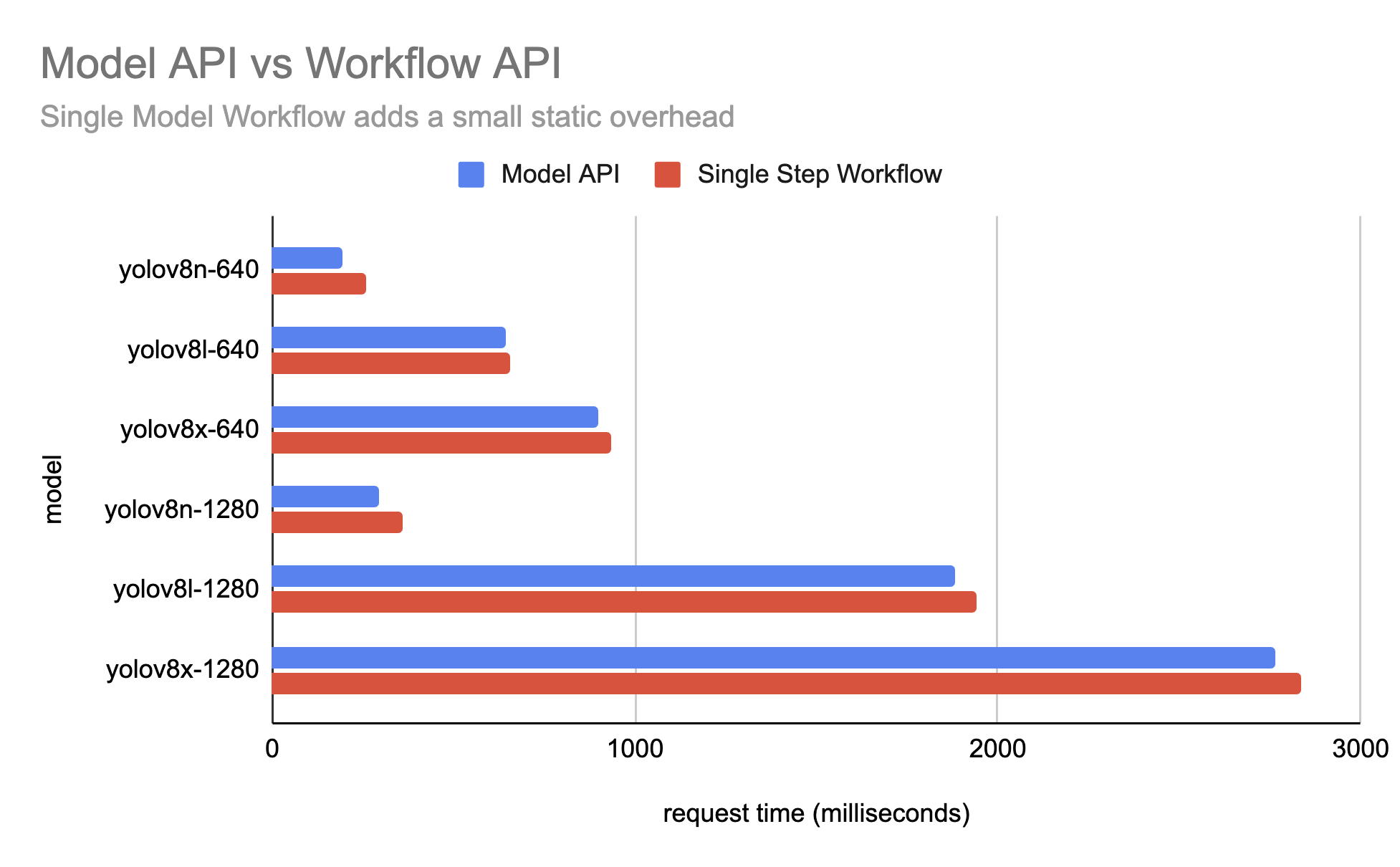
This page compares direct model inference latency versus Workflow-wrapped inference latency for popular detection models. The goal is to quantify the overhead introduced by the Workflows execution engine.
Self-Hosted Results
All times are in milliseconds. Each model was warmed up before timing, then measured over 10 iterations.
| Model | Avg Direct (ms) | Stddev Direct | Avg Workflow (ms) | Stddev Workflow |
|---|---|---|---|---|
| rfdetr-nano | 23.86 | 0.35 | 29.99 | 2.04 |
| rfdetr-small | 29.50 | 0.20 | 31.36 | 0.36 |
| rfdetr-medium | 33.97 | 0.54 | 34.78 | 0.23 |
| rfdetr-large | 40.96 | 0.38 | 46.00 | 1.75 |
| rfdetr-xlarge | 73.37 | 0.26 | 74.41 | 0.13 |
| yolo26n-640 | 7.68 | 0.04 | 9.61 | 0.43 |
| yolo26s-640 | 10.10 | 0.08 | 12.48 | 1.04 |
| yolo26m-640 | 16.43 | 0.05 | 18.10 | 0.58 |
| yolo26l-640 | 18.50 | 0.09 | 20.01 | 0.38 |
| yolo26x-640 | 30.46 | 0.14 | 33.51 | 0.17 |
Key Takeaways
- Workflow overhead is minimal — typically 1–5 ms on top of direct inference, depending on the model.
- For larger models (e.g.
rfdetr-xlarge), the workflow overhead becomes negligible relative to model inference time (~1.4%). - For smaller, faster models (e.g.
yolo26n-640), the overhead is proportionally larger (~25%) but still under 2 ms in absolute terms. - Workflow overhead is CPU-bound (graph scheduling, input preparation, output routing), while model inference itself typically runs on the GPU (when available). As a result, the overhead stays relatively constant regardless of GPU speed.
Methodology
- GPU-accelerated inference (results will vary by hardware).
- Warmup: Each model and workflow engine is warmed up with one inference call before timing begins.
- Iterations: 10 timed iterations per method, per model.
- Direct inference: Uses
get_model()and callsmodel.infer()directly. - Workflow inference: Wraps the same model in a minimal single-step workflow and runs it through the Execution Engine.
Click to expand benchmark script
import os
import statistics
import time
import argparse
import csv
import requests
import numpy as np
from PIL import Image
from io import BytesIO

from inference import get_model
from inference.core.env import WORKFLOWS_MAX_CONCURRENT_STEPS, MAX_ACTIVE_MODELS
from inference.core.managers.base import ModelManager
from inference.core.managers.decorators.fixed_size_cache import WithFixedSizeCache
from inference.core.registries.roboflow import RoboflowModelRegistry
from inference.core.workflows.core_steps.common.entities import StepExecutionMode
from inference.core.workflows.execution_engine.core import ExecutionEngine
from inference.models.utils import ROBOFLOW_MODEL_TYPES


def build_workflow(model_id: str) -> dict:
    """Build a minimal workflow definition for a given model (detection or classification)."""
    if "classifiers" in model_id or "classification" in model_id:
        step_type = "RoboflowClassificationModel"
    else:
        step_type = "RoboflowObjectDetectionModel"

    return {
        "version": "1.0",
        "inputs": [
            {"type": "WorkflowImage", "name": "image"},
        ],
        "steps": [
            {
                "type": step_type,
                "name": "model_step",
                "image": "$inputs.image",
                "model_id": model_id,
            }
        ],
        "outputs": [
            {
                "type": "JsonField",
                "name": "predictions",
                "selector": "$steps.model_step.predictions",
            },
        ],
    }


def main():
    parser = argparse.ArgumentParser(description="Benchmark direct inference vs. Workflow inference latency.")
    parser.add_argument("--iterations", type=int, default=10, help="Number of timed iterations per method (default: 10)")
    args = parser.parse_args()

    # Models, same list as benchmark.py
    models = [
        "classifiers/3",
        "yolo26n-640", "yolo26s-640", "yolo26m-640", "yolo26l-640", "yolo26x-640",
        "rfdetr-nano", "rfdetr-small", "rfdetr-medium", "rfdetr-large", "rfdetr-xlarge", "rfdetr-2xlarge",
    ]

    # Download the test image once
    print("Downloading test image...")
    url = "https://media.roboflow.com/inference/people-walking.jpg"
    response = requests.get(url)
    image = Image.open(BytesIO(response.content)).convert("RGB")
    image_np = np.array(image)
    print("Image ready.")

    # Initialize shared model manager for Workflow engine (reused across models)
    model_registry = RoboflowModelRegistry(ROBOFLOW_MODEL_TYPES)
    model_manager = ModelManager(model_registry=model_registry)
    model_manager = WithFixedSizeCache(model_manager, max_size=MAX_ACTIVE_MODELS)

    workflow_init_parameters = {
        "workflows_core.model_manager": model_manager,
        "workflows_core.step_execution_mode": StepExecutionMode.LOCAL,
    }

    results_file = os.path.join(os.path.dirname(os.path.abspath(__file__)), "benchmark_inference_vs_workflows.csv")
    fieldnames = [
        "model_id",
        "avg_latency_direct_ms", "min_direct_ms", "max_direct_ms", "stddev_direct_ms",
        "avg_latency_workflow_ms", "min_workflow_ms", "max_workflow_ms", "stddev_workflow_ms",
    ]

    with open(results_file, "w", newline="") as f:
        writer = csv.DictWriter(f, fieldnames=fieldnames)
        writer.writeheader()

    print(f"\nRunning {args.iterations} iterations per method for {len(models)} models...\n")

    for model_id in models:
        print(f"--- Model: {model_id} ---")

        # ── 1. Direct inference ──────────────────────────────────────────────
        direct_latencies = None
        try:
            model = get_model(model_id=model_id)

            # warmup
            model.infer(image_np)

            direct_latencies = []
            for i in range(args.iterations):
                t0 = time.perf_counter()
                model.infer(image_np)
                t1 = time.perf_counter()
                ms = (t1 - t0) * 1000.0
                direct_latencies.append(ms)
                print(f"  Direct   [{i+1:>2}/{args.iterations}]: {ms:.2f} ms")

            avg = statistics.mean(direct_latencies)
            mn  = min(direct_latencies)
            mx  = max(direct_latencies)
            sd  = statistics.stdev(direct_latencies) if len(direct_latencies) > 1 else 0.0
            print(f"  Direct   → avg={avg:.2f}  min={mn:.2f}  max={mx:.2f}  stddev={sd:.2f} ms")

        except Exception as e:
            print(f"  Direct FAILED: {e}")

        # ── 2. Workflow inference ────────────────────────────────────────────
        workflow_latencies = None
        try:
            workflow_def = build_workflow(model_id)

            engine = ExecutionEngine.init(
                workflow_definition=workflow_def,
                init_parameters=workflow_init_parameters,
                max_concurrent_steps=WORKFLOWS_MAX_CONCURRENT_STEPS,
            )

            # warmup
            engine.run(runtime_parameters={"image": [image_np]})

            workflow_latencies = []
            for i in range(args.iterations):
                t0 = time.perf_counter()
                engine.run(runtime_parameters={"image": [image_np]})
                t1 = time.perf_counter()
                ms = (t1 - t0) * 1000.0
                workflow_latencies.append(ms)
                print(f"  Workflow [{i+1:>2}/{args.iterations}]: {ms:.2f} ms")

            avg = statistics.mean(workflow_latencies)
            mn  = min(workflow_latencies)
            mx  = max(workflow_latencies)
            sd  = statistics.stdev(workflow_latencies) if len(workflow_latencies) > 1 else 0.0
            print(f"  Workflow → avg={avg:.2f}  min={mn:.2f}  max={mx:.2f}  stddev={sd:.2f} ms")

        except Exception as e:
            print(f"  Workflow FAILED: {e}")

        # ── Write row ────────────────────────────────────────────────────────
        def fmt(vals, fn):
            return round(fn(vals), 2) if vals else "FAIL"

        row = {
            "model_id": model_id,
            "avg_latency_direct_ms":  fmt(direct_latencies,   statistics.mean),
            "min_direct_ms":          fmt(direct_latencies,   min),
            "max_direct_ms":          fmt(direct_latencies,   max),
            "stddev_direct_ms":       fmt(direct_latencies,   lambda v: statistics.stdev(v) if len(v) > 1 else 0.0),
            "avg_latency_workflow_ms": fmt(workflow_latencies, statistics.mean),
            "min_workflow_ms":         fmt(workflow_latencies, min),
            "max_workflow_ms":         fmt(workflow_latencies, max),
            "stddev_workflow_ms":      fmt(workflow_latencies, lambda v: statistics.stdev(v) if len(v) > 1 else 0.0),
        }

        with open(results_file, "a", newline="") as f:
            writer = csv.DictWriter(f, fieldnames=fieldnames)
            writer.writerow(row)

        print(f"  Saved.\n")

    print(f"All done! Results: {results_file}")


if __name__ == "__main__":
    main()
Cloud-Hosted Results
The following results were benchmarked on the hosted Serverless API. Some notes:
- Compared to self-hosted results, Serverless server also needs to fetch the Workflow schema and model weights (whereas Serverless model inference only fetches weights)
- There's a static 10-50ms latency overhead for Workflows